Nvidia’s $1 Trillion AI Chip Forecast: The "Rubin" Era Begins
Nvidia’s $1T forecast at GTC 2026 marks the Rubin era. Explore how Jensen Huang’s bold AI chip vision is reshaping startups etc
TECH NEWS
Saad Rizwan
3/19/20263 min read
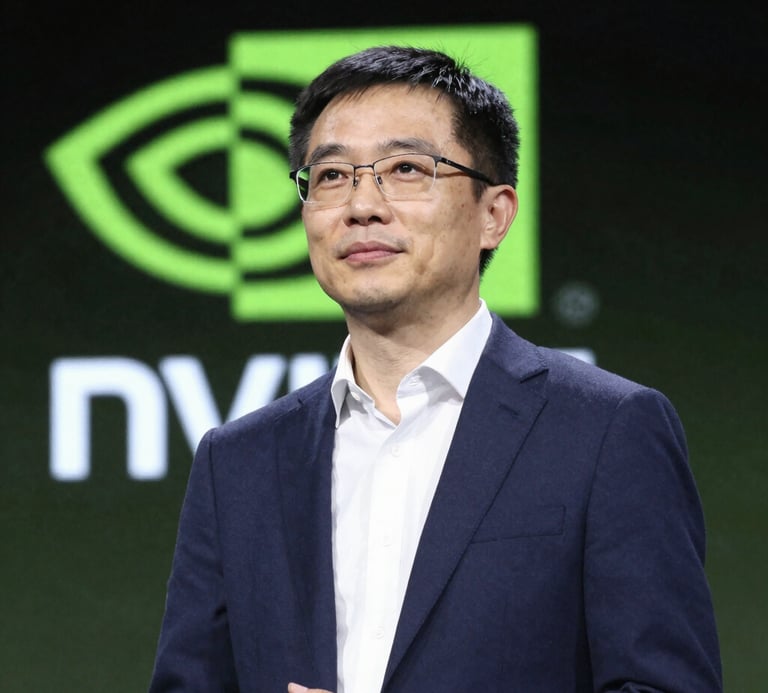
The tech world just received a trillion-dollar wake-up call. At GTC 2026, Nvidia CEO Jensen Huang didn't just announce new hardware; he unveiled a roadmap that effectively doubles the company’s revenue outlook.
Nvidia has projected a staggering $1 trillion in revenue opportunity through 2027, driven by the transition from AI training to the "Age of Inference." This isn't just a financial milestone—it’s a gravitational force reshaping everything from data center design to the global supply chain.
1. The Vera Rubin Platform: A 10x Leap in Efficiency
For the past year, the Blackwell (B200) architecture was the gold standard. But the new Vera Rubin platform, named after the legendary astronomer, is designed for a world where AI doesn't just "talk"—it "acts."
Vera CPU: An 88-core Arm-based powerhouse built on TSMC’s 3nm node, designed to eliminate the bottlenecks of traditional processors.
Rubin GPU: Delivering a massive 50 petaflops of FP4 inference performance, the Rubin GPU features 288GB of HBM4 memory.
The Groq Integration: In a landmark move, Nvidia integrated technology from its $20 billion acquisition of Groq. This allows the Rubin platform to handle "token prefilling" and real-time inference at speeds 350x faster than previous generations.
2. Why "Inference" is the New Tech Battleground
If 2024 was the year of training (teaching models), 2026 is the year of inference (running models in the real world).
Jensen Huang declared that 85% of AI workloads are shifting toward inference. This shift is giving birth to "Agentic AI"—autonomous digital agents capable of multi-step reasoning. To support this, Nvidia is transforming data centers into "AI Factories" that produce tokens as a primary commodity.
Beyond Blackwell: How Nvidia’s Rubin Chip Will Rule 2026
Nvidia’s latest forecast shows they are targeting a $1 trillion market as they move into the new "Rubin" chip era. This next generation of technology is a massive leap forward from the previous Blackwell chips, offering nearly double the speed and much higher efficiency. Built on advanced 3nm technology, these Rubin chips are designed specifically to handle the incredibly complex AI models of 2026 and 2027.
The shift is moving away from just "teaching" AI to actually "using" it in real-time, which requires much more power. By combining faster memory and specialized processing, Nvidia is making it possible for AI to reason and act autonomously. This is reshaping the entire tech industry, forcing data centers to upgrade their cooling and power systems just to keep up. While competitors are trying to build their own chips, Nvidia's massive lead in speed and software is currently setting the gold standard for the future of global computing.
3. The "Sovereign AI" Gold Rush
Nvidia’s $1 trillion forecast is heavily padded by the rise of Sovereign AI. Nations like Japan, India, and various European states are no longer content relying on US-based clouds. They are building their own domestic AI infrastructure using Nvidia’s specialized stacks to ensure data privacy and cultural alignment.
This "nationalization" of AI infrastructure creates a secondary market for liquid cooling providers, power grid specialists, and networking giants like Broadcom and Marvell, who are all riding Nvidia's coattails.
4. Challenges: Can the Momentum Hold?
Despite the bullish forecast, industry analysts have raised three critical questions:
Hyperscaler Competition: Google’s TPU v7 and Amazon’s Trainium3 are becoming viable, lower-cost alternatives for specific tasks.
The Cooling Crisis: A single Rubin Ultra rack can pull 600 kW of power. Data centers are literally hitting a "thermal wall" that requires massive infrastructure overhauls.
Market Saturation: Can enterprise ROI keep pace with Nvidia’s $100,000+ chip prices?
The TechySphere Verdict
Nvidia’s Rubin architecture isn't just a chip; it's the foundation of a new industrial era. By vertically integrating CPUs, GPUs, and high-speed networking, Nvidia has built a "moat" that is currently wider than any other in tech history.
For the tech industry, the message is clear: the infrastructure of the next decade is being written in NVLink and HBM4.