How Artificial Intelligence is Transforming Everyday Life in 2026
Discover how Artificial Intelligence is changing daily life in 2026, from smart homes and healthcare to education, transportation, and business innovations.
TECH NEWS
6/15/20263 min read
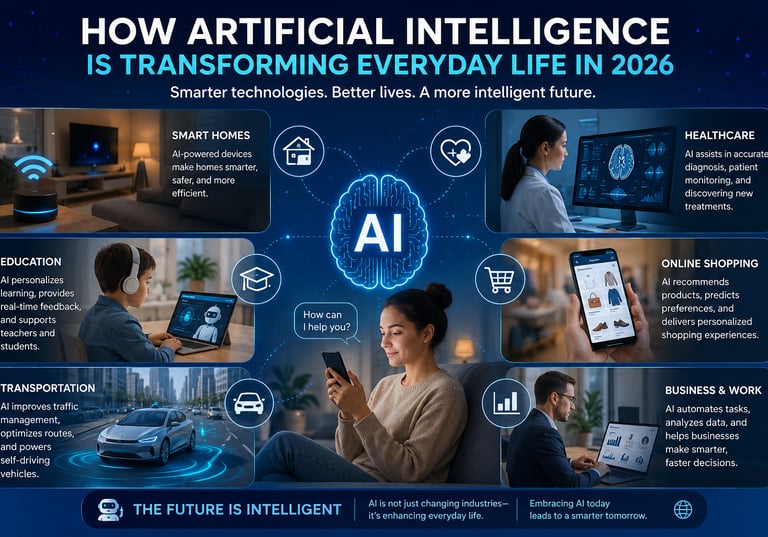
Artificial Intelligence (AI) is no longer a futuristic concept found only in science fiction movies. In 2026, AI has become an essential part of everyday life, influencing how we work, learn, communicate, shop, and even manage our health. From virtual assistants to personalized recommendations, AI-powered technologies are helping people save time, improve productivity, and make better decisions.
In this article, we'll explore how Artificial Intelligence is transforming everyday life and what the future may hold for this revolutionary technology.
What is Artificial Intelligence?
Artificial Intelligence refers to computer systems designed to perform tasks that typically require human intelligence. These tasks include learning, problem-solving, decision-making, speech recognition, language translation, and image analysis.
Modern AI systems use machine learning algorithms and vast amounts of data to improve their performance over time, making them increasingly accurate and efficient.
AI in Smart Homes
One of the most visible applications of AI is in smart home technology. AI-powered devices can learn user preferences and automate everyday tasks.
Examples include:
Smart thermostats that adjust temperatures automatically.
Voice assistants that answer questions and control devices.
Security cameras that detect unusual activities.
Smart lighting systems that adapt to your routine.
These technologies enhance convenience while helping homeowners reduce energy consumption and improve security.
AI in Healthcare
Healthcare is experiencing a major transformation thanks to Artificial Intelligence.
AI is being used to:
Assist doctors in diagnosing diseases.
Analyze medical images more accurately.
Monitor patients remotely.
Predict potential health risks.
Accelerate drug discovery and research.
By improving diagnostic accuracy and reducing administrative workloads, AI allows healthcare professionals to focus more on patient care.
AI in Education
Educational institutions are increasingly integrating AI into learning environments.
Benefits include:
Personalized learning experiences.
Intelligent tutoring systems.
Automated grading and assessments.
Language learning assistance.
Real-time feedback for students.
AI helps educators identify learning gaps and tailor teaching methods to meet individual student needs, making education more effective and accessible.
AI in Transportation
The transportation industry is rapidly adopting AI-driven solutions.
Applications include:
Navigation and route optimization.
Traffic prediction systems.
Autonomous vehicle development.
Fleet management solutions.
Predictive maintenance for vehicles.
These innovations improve safety, reduce travel times, and enhance overall transportation efficiency.
AI in Business and Customer Service
Businesses across industries are leveraging AI to improve operations and customer experiences.
Common uses include:
AI chatbots for customer support.
Automated data analysis.
Demand forecasting.
Marketing personalization.
Fraud detection.
Companies can better understand customer behavior, streamline workflows, and make data-driven decisions that boost profitability.
AI in Online Shopping
E-commerce platforms rely heavily on Artificial Intelligence to create personalized shopping experiences.
AI helps retailers:
Recommend relevant products.
Predict customer preferences.
Optimize inventory management.
Detect fraudulent transactions.
Improve search functionality.
As a result, customers enjoy more convenient and personalized online shopping experiences.
Challenges of Artificial Intelligence
Despite its many advantages, AI also presents several challenges.
Key concerns include:
Data privacy and security.
Algorithmic bias.
Job displacement due to automation.
Ethical decision-making.
Dependence on technology.
Addressing these challenges responsibly will be crucial to ensuring AI benefits society as a whole.
The Future of Artificial Intelligence
The future of AI looks incredibly promising. As technology continues to evolve, we can expect smarter digital assistants, more advanced healthcare solutions, improved automation, and new innovations that enhance our daily lives.
Organizations and governments worldwide are investing heavily in AI research, making it one of the most influential technologies of the 21st century.
Artificial Intelligence is transforming the way we live, work, and interact with technology. From smart homes and healthcare to education and business, AI is creating opportunities for greater efficiency, convenience, and innovation. While challenges remain, the continued development of responsible AI technologies will shape a future where humans and intelligent systems work together to solve complex problems and improve quality of life.
As AI becomes more integrated into our daily routines, understanding its impact will be essential for individuals, businesses, and society alike.